Bookkeeping Engagement Letter Template
15 min read
Last updated: July 2026
A bookkeeping engagement letter sets the rules before the work starts. It defines what services are included, what the client must provide, when documents are due, how fees work, and what happens when the client asks for extra work.
For bookkeeping firms managing QuickBooks clients, the engagement letter should do more than protect the firm. It should also create a clean operating rhythm for month-end close.
A bookkeeping engagement letter should clearly define scope, fees, client responsibilities, document submission deadlines, access requirements, out-of-scope work, and termination terms before bookkeeping begins.
This page includes a copy-paste bookkeeping engagement letter template and a clause-by-clause walkthrough.
Use this alongside your bookkeeping client onboarding checklist so the signed agreement becomes step one of a clean onboarding process.
Important note: This template is for general educational use only. It is not legal advice. Before using it with clients, have it reviewed by a qualified attorney in your jurisdiction and adapt it to your firm, services, insurance requirements, and state rules.
Free Bookkeeping Engagement Letter Template
Copy the template below into your document editor, replace the bracketed fields, and customize it for your firm.
Bookkeeping Engagement Letter
Date: [Month Day, Year]
Bookkeeping Firm: [Your Firm Name]
Client: [Client Legal Name]
Business Name: [Client Business Name, if different]
Engagement Start Date: [Start Date]
Dear [Client Name],
Thank you for choosing [Your Firm Name] to provide bookkeeping services for [Client Business Name]. This engagement letter confirms the scope of our services, your responsibilities as the client, our responsibilities as the bookkeeping firm, and the terms under which we will work together.
Please review this letter carefully. If the terms are acceptable, sign and return a copy before services begin.
1. Scope of Services
[Your Firm Name] will provide the following bookkeeping services:
- Monthly bookkeeping in QuickBooks Online
- Bank and credit card transaction categorization
- Bank and credit card reconciliations
- Receipt and invoice review
- Accounts payable support: [included / not included / describe]
- Accounts receivable support: [included / not included / describe]
- Monthly financial reports: [Profit and Loss, Balance Sheet, Cash Flow, other]
- Month-end close support
- Communication regarding bookkeeping questions and missing information
Services will be performed for the following entity or entities:
- [Legal Entity Name]
- [DBA, if applicable]
- [Additional entities, if applicable]
Unless specifically stated in this letter, the services above do not include tax preparation, payroll processing, sales tax filing, audit support, financial statement assurance, legal advice, business valuation, CFO advisory, loan application support, inventory accounting, or cleanup work for prior periods.
Any services not listed in this section are outside the scope of this engagement and may require a separate written agreement or additional fees.
2. Period Covered
This engagement covers bookkeeping services beginning on [Start Date].
Recurring bookkeeping services will be performed on a [monthly / quarterly / weekly] basis.
The first period covered will be:
- From: [Start Date]
- Through: [End Date or "ongoing until terminated"]
If prior-period cleanup is required before recurring bookkeeping can begin, cleanup work will be addressed separately in writing.
3. Client Responsibilities
You agree to provide complete, accurate, and timely information needed to perform the bookkeeping services.
Client responsibilities include:
- Providing access to QuickBooks Online
- Providing bank, credit card, loan, payroll, and merchant account access or statements
- Providing receipts, invoices, bills, deposits, loan documents, and other supporting records
- Responding to bookkeeping questions within [number] business days
- Reviewing financial reports and notifying us of any known errors or missing information
- Maintaining responsibility for business decisions, payments, approvals, and internal controls
- Confirming that all information provided is accurate and complete to the best of your knowledge
We will rely on the records and information you provide. You remain responsible for the accuracy, completeness, and business purpose of all transactions and supporting documents.
4. Document Submission Requirements
To complete bookkeeping on time, you agree to submit all required documents by the deadlines below.
Required documents may include:
- Receipts
- Vendor invoices
- Customer invoices
- Bills
- Bank statements
- Credit card statements
- Loan statements
- Payroll reports
- Merchant processor statements
- Deposit details
- Reimbursement records
- Any other documents needed to support transactions in QuickBooks
Monthly document deadline
You agree to submit all receipts, invoices, statements, and supporting documents by the [5th / 10th / other date] business day after month-end.
For example, documents for March must be submitted by [April 5 / April 10 / custom date].
Late or missing documents
If documents are late, missing, incomplete, unclear, or not submitted through the agreed process, the month-end close may be delayed.
If we need to spend additional time chasing documents, researching missing information, reworking entries, or reopening a closed period due to late client documents, additional fees may apply.
Required submission method
Documents must be submitted through the approved method:
- [Client document portal]
- [Dedicated client inbox]
- [Shared folder]
- [ScribeosAI document collection workflow]
- [Other approved method]
Documents sent by text message, personal email, or unapproved channels may not be processed unless we agree otherwise in writing.
5. QuickBooks Access and Connected Accounts
You agree to provide the access needed to perform the services listed in this letter.
This may include:
- QuickBooks Online accountant access
- Bank feed access
- Credit card feed access
- Payroll provider access
- Merchant processor access
- POS system access
- Loan account access
- Prior bookkeeper or accountant records, if applicable
If access is not provided or is later removed, our ability to complete the work may be delayed.
You are responsible for maintaining secure credentials, approving access requests, and notifying us of any changes to accounts, systems, or business activity.
6. Fees and Payment Terms
Our fees for the services described in this letter are:
- Recurring bookkeeping fee: $[amount] per [month / quarter]
- Setup or onboarding fee: $[amount, if applicable]
- Cleanup fee: $[amount or "to be quoted separately"]
- Out-of-scope hourly rate: $[amount] per hour
- Other fees: [describe]
Invoices are due [upon receipt / within 7 days / within 15 days / within 30 days].
If payment is not received on time, we may pause services until the account is current. Late fees may apply as described here:
[Insert late fee policy, if applicable.]
7. Out-of-Scope Work
The following services are not included unless agreed in writing:
- Prior-period cleanup
- Tax preparation or tax filing
- Payroll processing
- Sales tax filing
- 1099 filing
- Audit, review, or compilation services
- Financial statement assurance
- Budgeting or forecasting
- CFO advisory
- Inventory accounting
- Loan or investor reporting
- Custom management reporting
- Rebuilding books due to missing or inaccurate records
- Rework caused by late or incomplete client information
If you request services outside the agreed scope, we will confirm the work and fees before proceeding.
8. Timing and Delivery
We will make reasonable efforts to complete monthly bookkeeping by [target date], provided that:
- All required documents are submitted on time
- All accounts are connected or statements are provided
- Client questions are answered within the agreed response window
- There are no unusual transactions, missing records, access issues, or prior-period problems
Month-end close timing depends on timely client cooperation. If required information is late, incomplete, or unclear, delivery dates may change.
9. Review and Approval
We may ask you to review uncategorized transactions, missing receipts, unusual vendors, loan activity, payroll entries, owner draws, reimbursements, or other items that require client judgment.
You agree to review these questions and provide answers within [number] business days.
You remain responsible for final business decisions, including approving payments, classifying personal versus business expenses, confirming vendor relationships, and validating the business purpose of transactions.
10. Record Retention
You are responsible for maintaining your business records, including receipts, invoices, statements, contracts, tax documents, payroll records, and other supporting documentation.
We may retain copies of certain documents for our working files, but our records are not a substitute for your own recordkeeping obligations.
You should consult your tax advisor or attorney regarding record retention requirements for your business.
11. Confidentiality
We will keep your nonpublic business and financial information confidential, except as required to perform the services described in this letter, comply with law, respond to legal process, or work with authorized service providers.
You agree not to send sensitive information through unsecured channels unless we have approved that method in writing.
12. Use of Technology and Third-Party Tools
To perform bookkeeping services efficiently, we may use secure software tools for document collection, data extraction, workflow management, communication, and QuickBooks processing.
These tools may help collect receipts and invoices, extract transaction details, support review workflows, and organize documents.
You remain responsible for the accuracy and completeness of information submitted through any system. We remain responsible for professional judgment and review within the scope of this engagement.
13. No Audit, Review, Compilation, or Assurance
Our bookkeeping services do not constitute an audit, review, compilation, or other assurance engagement.
We will not express an opinion or provide assurance on your financial statements, internal controls, fraud prevention, tax compliance, or regulatory compliance.
Our work is based on the information you provide and the services described in this letter.
14. Limitation of Services
We are not responsible for detecting fraud, theft, illegal acts, or misstatements unless specifically agreed in writing.
We are not responsible for management decisions, payment approvals, tax positions, legal matters, hiring decisions, financing decisions, or business operations.
You are responsible for maintaining internal controls, safeguarding assets, and reviewing the financial information provided.
15. Changes to Scope
If your business changes significantly, the scope and fee may need to change.
Examples include:
- Adding new bank or credit card accounts
- Adding locations, classes, departments, or entities
- Increasing transaction volume
- Adding payroll, inventory, sales tax, loans, or merchant platforms
- Requesting cleanup or catch-up work
- Requiring faster close timelines
- Adding custom reporting
Any material change in scope may require a revised engagement letter, addendum, or fee change.
16. Termination
Either party may terminate this engagement with [number] days' written notice.
We may suspend or terminate services if:
- Required documents are not provided
- Access is not granted
- Payment is overdue
- Client communication is consistently delayed
- The requested work is outside our agreed scope
- Continuing the engagement would create a professional, ethical, legal, or operational concern
Fees for work performed through the termination date remain due.
17. Acceptance
By signing below, both parties agree to the terms of this engagement letter.
Bookkeeping Firm:
- Name: [Your Name]
- Title: [Your Title]
- Firm: [Your Firm Name]
- Signature: ___________________________
- Date: _______________________________
Client:
- Name: [Client Name]
- Title: [Client Title]
- Company: [Client Company]
- Signature: ___________________________
- Date: _______________________________
How to Use This Bookkeeping Engagement Letter Template
Do not send the template exactly as written without reviewing it.
Use it as a starting point. Then customize it based on:
- Your services
- Your pricing model
- Your state or country
- Whether you are a bookkeeper, CPA, enrolled agent, or accounting firm
- Whether you provide tax, payroll, advisory, or only bookkeeping
- Your insurance requirements
- Your document collection workflow
- Your QuickBooks access requirements
The goal is not to make the letter long. The goal is to make it clear.
A good engagement letter should answer three questions before the client signs:
- What exactly are we doing?
- What does the client need to provide?
- What happens if the client delays, expands scope, or withholds information?
Clause-by-Clause Walkthrough
| Clause | Why it matters | What to customize |
|---|---|---|
| Scope of services | Prevents clients from assuming tax, payroll, cleanup, or advisory work is included | List included and excluded services |
| Period covered | Clarifies whether work starts now, includes prior periods, or continues monthly | Start date, cleanup period, recurring cadence |
| Client responsibilities | Makes the client responsible for accurate and complete information | Response deadlines and required records |
| Document submission | Turns receipt and invoice deadlines into a written expectation | Deadline, approved channels, late-document policy |
| QuickBooks access | Prevents onboarding delays caused by missing logins or permissions | QBO access, bank feeds, payroll, POS, merchant accounts |
| Fees | Reduces billing disputes and scope creep | Monthly fee, setup fee, cleanup fee, hourly rate |
| Out-of-scope work | Protects margin when clients ask for extra work | Cleanup, tax, payroll, custom reporting, rework |
| Timing | Makes close deadlines dependent on client cooperation | Monthly close date and client response window |
| Technology | Allows the firm to use workflow tools without renegotiating every process | Document portal, dedicated inbox, automation tools |
| No assurance | Clarifies that bookkeeping is not an audit, review, or compilation | CPA-specific wording if applicable |
| Termination | Gives both sides a clean exit path | Notice period and suspension triggers |
The Most Important Clause: Document Submission
Most bookkeeping problems do not start in QuickBooks. They start before QuickBooks.
- The client forgets receipts.
- The client sends invoices by text.
- The client uploads half the statements.
- The client answers questions after close is already late.
- The bookkeeper becomes the person chasing documents instead of closing books.
That is why the document-submission clause matters.
It should say:
- What documents the client must send
- When they must send them
- Where they must send them
- What happens if they are late
- Whether extra chasing, rework, or reopening periods may create additional fees
Here is a shorter version you can use if you want a tighter clause:
Client agrees to submit all receipts, invoices, statements, bills, deposit details, and other supporting documents by the [Xth] business day after month-end through the approved submission method. If documents are late, incomplete, unclear, or submitted through unapproved channels, monthly bookkeeping delivery may be delayed and additional fees may apply for follow-up, research, rework, or reopening closed periods.
This is not just legal language. It is an operating rule.
If the client signs it, you have a clear reason to enforce the process later.
For more on this problem, see stop chasing clients for receipts.
Where Automation Fits After the Letter Is Signed
The engagement letter sets the expectation. Your workflow enforces it.
Once the client agrees to send receipts and invoices through a specific process, you need a system that makes that easy for both sides.
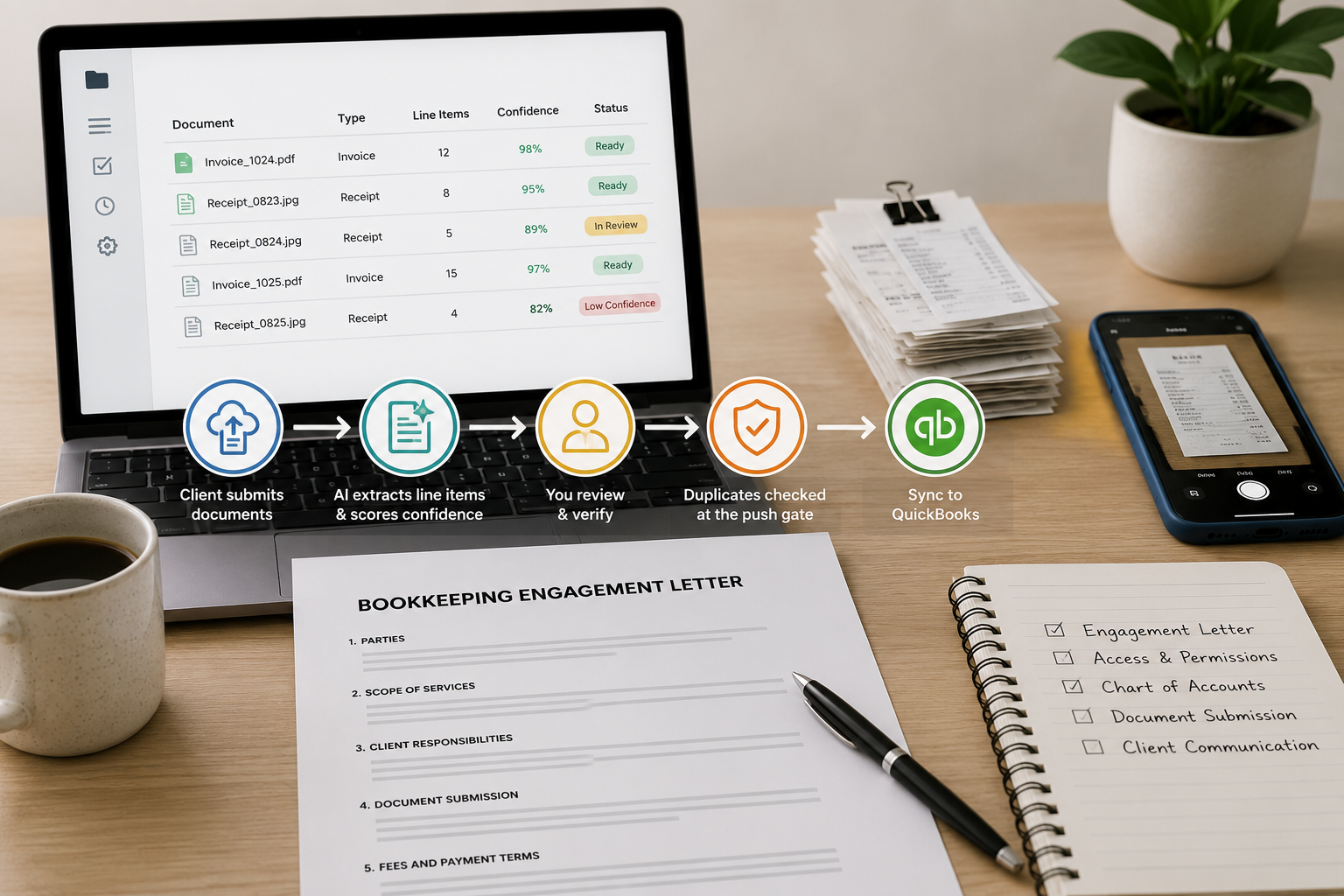
For QuickBooks bookkeeping firms, the ideal workflow looks like this:
- Client submits receipts, invoices, and supporting documents through the approved channel.
- Documents are separated by client.
- Receipt and invoice data is extracted.
- Line items and key fields are reviewed.
- Low-confidence fields are checked by a human.
- Duplicates are flagged before anything is posted.
- Approved items sync to QuickBooks.
That is where client document collection becomes more than an admin task.
ScribeosAI is built for QuickBooks-first receipt and invoice automation. The workflow is:
client document collection → AI extraction with line items and confidence scoring → human review → duplicate detection → QuickBooks sync
This matters because the engagement letter can say "send documents on time," but the firm still needs a repeatable way to receive, review, and post those documents without turning month-end into manual chasing.
ScribeosAI is a strong fit when your firm manages multiple QuickBooks clients and wants flat pricing with unlimited clients, no per-client fees, line-item extraction included, review before posting, and duplicate detection at the push gate.
It may not be the right fit if you only manage one or two clients, do not use QuickBooks, or prefer to keep all receipt handling fully manual.
For more on collecting documents from clients, see how to collect receipts from clients.
Example Document Submission Clause for ScribeosAI Users
If your firm uses ScribeosAI or a similar document collection workflow, you can adapt this clause:
Client agrees to submit receipts, invoices, bills, statements, and supporting documents through the document submission process designated by [Firm Name]. Documents should not be sent by text message, personal email, or other unapproved channels unless agreed in writing. The firm may use bookkeeping automation tools to collect documents, extract transaction details, support review, identify potential duplicates, and prepare approved items for QuickBooks. Client remains responsible for submitting complete and accurate records and responding to questions by the agreed deadline.
This clause does two things.
First, it tells the client where documents belong.
Second, it explains that automation supports the workflow, but the client is still responsible for complete and accurate records.
That distinction matters.
Automation can reduce manual entry. It cannot replace client cooperation or professional review.
Common Mistakes to Avoid
Mistake 1: Using a generic template without editing scope
A generic engagement letter may say "bookkeeping services" without defining what that means.
That creates problems later.
- Does bookkeeping include payroll?
- Does it include sales tax?
- Does it include cleanup?
- Does it include custom reports?
- Does it include responding to lender requests?
Define the scope before the client signs.
Mistake 2: Forgetting to exclude services
The exclusions are as important as the included services.
If you do not provide tax filing, say that.
If cleanup is separate, say that.
If advisory work is extra, say that.
A clear exclusion is not negative. It protects both sides.
Mistake 3: Leaving document deadlines vague
"Please send receipts monthly" is weak.
"Submit all receipts, invoices, statements, and supporting documents by the 5th business day after month-end through the approved document portal" is better.
The more specific the process, the easier it is to enforce.
Mistake 4: Not pricing rework
Late documents create hidden labor.
- A client sends a missing receipt after reconciliation.
- A vendor invoice arrives after reports were sent.
- A loan statement appears after the month is closed.
- A personal expense needs to be corrected after categorization.
That time should not silently reduce your margin.
Add language for follow-up, rework, reopening periods, and out-of-scope work.
Mistake 5: Promising close dates without client conditions
Do not promise a month-end close date without tying it to client cooperation.
Better language:
We will make reasonable efforts to complete monthly bookkeeping by [date], provided all required documents are submitted on time and all client questions are answered within [number] business days.
This keeps the timeline fair.
Mistake 6: Ignoring QuickBooks access
Many onboarding delays happen because the firm does not have proper access.
Your letter should require access to QuickBooks Online, bank feeds, credit cards, payroll, merchant processors, POS systems, and any other system needed for the work.
If access is missing, deadlines move.
When This Template Is Enough
This template may be enough as a starting point if:
- You provide recurring bookkeeping only
- You serve simple QuickBooks Online clients
- You have a standard monthly close process
- You do not provide audit, assurance, tax filing, payroll, or advisory work
- You plan to have the final version reviewed by an attorney
It is a practical starting point for solo bookkeepers and small firms that need a better client agreement before onboarding.
When You Need a More Customized Agreement
You should get a more customized engagement letter if:
- You are a CPA firm
- You provide tax, payroll, advisory, or CFO services
- You work with complex entities
- You support multiple locations or franchises
- You handle trust accounts, client funds, or regulated industries
- You provide financial statement preparation or assurance services
- You have state board, insurance, or professional body requirements
- You serve clients with high transaction volume or complex revenue streams
The more risk in the engagement, the more customized the letter should be.
Proof: Why the Workflow After the Letter Matters
An engagement letter creates the rule. The workflow makes the rule usable.
VNB Consulting reduced manual data entry time by nearly 90% using ScribeosAI.
ScribeosAI is also used by Diya Hospitality.
For firms managing recurring QuickBooks clients, the value is not just extracting data from receipts. It is creating a reviewable workflow: collect documents, extract line items, flag confidence issues, review before posting, catch duplicates, and sync approved data to QuickBooks.
Final Checklist Before You Send the Engagement Letter
Before sending your bookkeeping engagement letter, confirm that it answers these questions:
- Are the included services clear?
- Are excluded services clear?
- Is cleanup treated separately?
- Are client responsibilities specific?
- Are document deadlines written down?
- Is the approved submission method named?
- Are late documents and rework addressed?
- Are QuickBooks access requirements listed?
- Are fees and payment terms clear?
- Is there a termination clause?
- Has the final version been reviewed by an attorney?
If the answer is yes, the letter is ready to support a cleaner onboarding process.
If the answer is no, fix the letter before you start the work.
A signed engagement letter will not make every client organized. But it gives your firm a clear standard to point back to when receipts are late, scope expands, or month-end starts slipping.
That is the difference between asking clients to cooperate and building cooperation into the agreement.
FAQ
What is a bookkeeping engagement letter?
A bookkeeping engagement letter is a written agreement between a bookkeeping firm and a client. It defines the services included, client responsibilities, fees, timing, document requirements, and scope limits before work begins.
Do bookkeepers need an engagement letter?
Yes, bookkeepers should use engagement letters for recurring client work. The letter helps prevent scope creep, billing disputes, late document issues, and confusion about what services are included.
Is a bookkeeping engagement letter legally binding?
It can be, depending on the wording, signatures, jurisdiction, and applicable law. Have your engagement letter reviewed by an attorney before using it with clients.
What should be included in a bookkeeping engagement letter?
A bookkeeping engagement letter should include scope of services, excluded services, client responsibilities, document submission deadlines, QuickBooks access requirements, fees, payment terms, timing, confidentiality, technology use, and termination terms.
Should receipt deadlines be included in the engagement letter?
Yes. Receipt, invoice, and statement deadlines should be included in the engagement letter so clients understand that timely document submission is part of the agreement.
Can I use this bookkeeping engagement letter template as-is?
Use it as a starting point, not as final legal language. Customize it for your services, pricing, location, client type, and workflow, then have it reviewed by an attorney.
What is the difference between an engagement letter and an onboarding checklist?
The engagement letter is the agreement that defines the relationship and scope. The onboarding checklist is the operational process used after signing to collect access, documents, contacts, and workflow details.
How does ScribeosAI fit into a bookkeeping engagement letter?
ScribeosAI fits into the document-submission and technology-use sections. It helps firms collect client documents, extract receipt and invoice data, review before posting, detect duplicates, and sync approved items to QuickBooks.